
RESOURCES
HERE YOU WILL FIND VALUABLE INFORMATION ON INDUSTRY LEADERSHIP, PARTNER ORGANIZATIONS, ASSETS AND BACKGROUND MATERIALS TO GIVE USERS A CLEARER UNDERSTANDING OF THIS VITAL ISSUE.
What is ICB
NFPA
Smoke Control Systems (SCS) are addressed in Chapters 9 of the IFC and IBC, which in turn, reference NFPA Standard 92. NFPA 92-2024 8.6 calls for testing smoke control systems semiannually for dedicated systems or annually for non-dedicated systems. Descriptions of smoke control system function can be found in Section 513 of the IMC.
Reading a Report
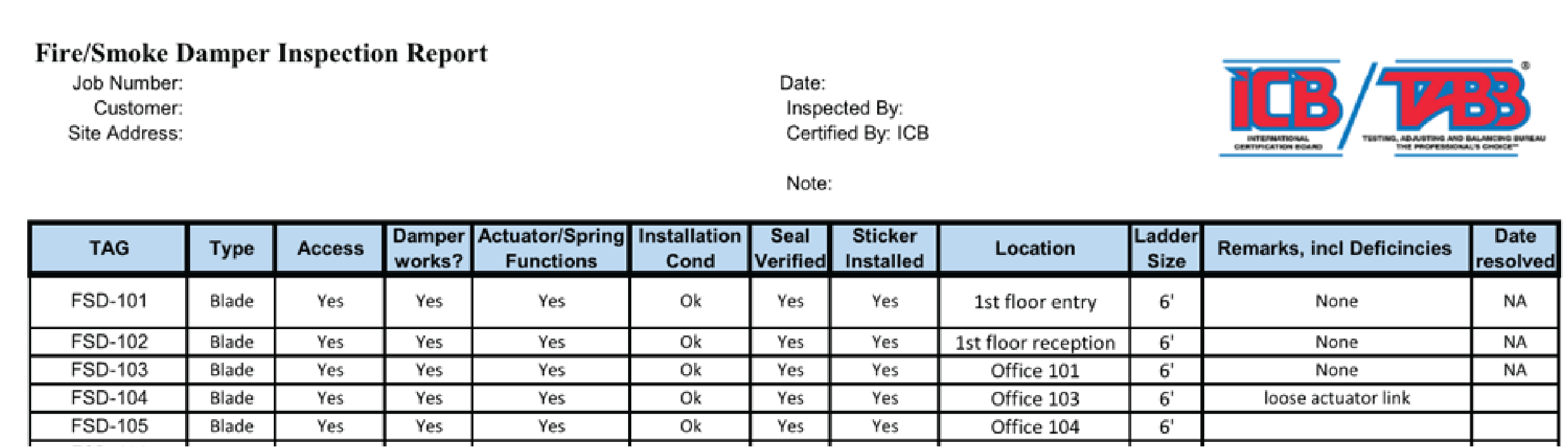
NFPA Standards require specific information to be included with documentation of inspections and testing of Fire and Smoke Dampers and Smoke Control Systems. For example, NFPA 105-2025 7.5.2.2 & NFPA 80-2025 20.3.4 documentation cites location of the damper, date of inspection, name of inspector and deficiencies discovered, with space to indicate when and how deficiencies were corrected.
A report should clearly and concisely summarize where every and all dampers are located and can be best accessed.
ICB-certified HVAC Fire Life Safety professionals write reports which meet or exceed these requirements and are clearly identified with a professional mark indicating the work was completed by a person certified as possessing the knowledge and skills required to do the work.
Definitions
ANSI National Accreditation Board (ANAB) – A non-governmental organization that provides accreditation services and training to public- and private-sector organizations, serving the global marketplace. ANAB is the largest accreditation body in North America and provides services in more than 75 countries.
ANAB Accreditation – Recognizes the competence of bodies to carry out activities in accordance with requirements defined in international standards. ANAB’s accreditation programs operate in accordance with international guidelines and have been verified by government and peer review assessments.
ICB-certified Fire and Smoke Damper Professionals – Those who have demonstrated possession of knowledge and skills required for the inspection and maintenance of fire and smoke dampers in HVAC systems.
ICB-certified Smoke Control Systems Professionals – Those who have demonstrated possession of the knowledge and skills required to inspect and test smoke management and stairway pressurization systems.
Fire Dampers – Fire protection equipment used in heating, ventilation and air conditioning ducts to prevent the spread of fire inside the ductwork.
HVAC – Heating, ventilation and air conditioning
HVAC Fire Life Safety – Heating, ventilation and air conditioning systems which are part of the fire life safety systems of a building, including fire and smoke dampers and smoke control systems.
HVAC Fire Life Safety Professionals – Those who take HVAC Fire Life Safety courses and pass a series of exams become ICB-certified HVAC Fire and Smoke Damper (FSD) Technicians, Supervisors or Contractors, and/or Smoke Control Systems Technicians, Supervisors or Contractors.
ICB (International Certification Board) – The mission of the ICB is to direct and implement a comprehensive set of certification programs to assure customers of the sheet metal industry of the quality advantages of utilizing persons or entities certified by the ICB. The ICB is the industry leader in HVAC fire and smoke damper and smoke control systems certifications. ICB certification is a statement that the technician, supervisor and contractor demonstrate the highest level of professional expertise.
ISO/IEC 17024 – Standard that provides an international benchmark for personnel certification programs to ensure that they operate in a consistent, comparable and reliable manner.
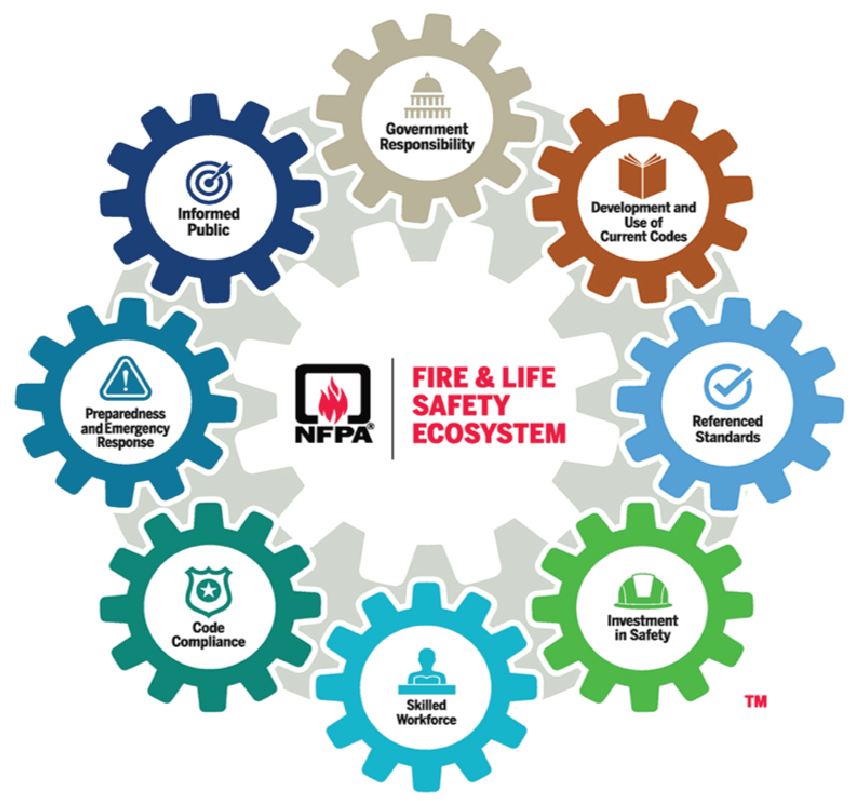
NFPA (National Fire Protection Association) – International, nonprofit organization established in 1896 devoted to eliminating death, injury, property and economic loss due to fire, electrical and related hazards. NFPA delivers information and knowledge through more than 300 consensus codes and standards, research, training, education, outreach and advocacy; and by partnering with others who share an interest in furthering its mission.
Smoke Dampers – Smoke protection equipment designed to keep fumes, carbon monoxide and other toxins safely confined to smaller spaces. A report should clearly and concisely summarize where every and all dampers are located and can be best accessed.
Awareness Training
FLS Damper professionals are properly and thoroughly trained to inspect, test, maintain and repair fire and smoke dampers according to requirements in NFPA Codes and Standards, helping to ensure that these crucial life safety features will work in an emergency.
The National Energy Management Institute (NEMI) advocates for fire life safety ordinances across the country that require building owners to use a certified, skilled and trained workforce to conduct the periodic inspections of fire and smoke dampers according to requirements in NFPA Codes and Standards.
UMD Research Study
NEMIC, in conjunction with the University of Maryland Department of Fire Protection Engineering, set out to study the reliability of smoke control systems and life safety dampers installed in HVAC systems.
Dr. James Milke, professor and chair of the Department of Fire Protection Engineering, and Ph.D. candidate Robert Ayoub conducted the study to create awareness of the importance of periodic inspection of fire dampers, smoke dampers and smoke control systems.
The principal approach for the research study included collection of data from inspections and post-incident investigations of the performance of fire dampers, smoke dampers, and smoke control systems. A survey was distributed to contractors, engineering consultants, and government agencies who conduct such inspections.
The results of the survey identified that issues for FLS dampers in existing buildings were widespread and that FLS dampers in new buildings were not immune from showing evidence of problems. The issues for smoke control systems were more prominent in new buildings than existing buildings.